
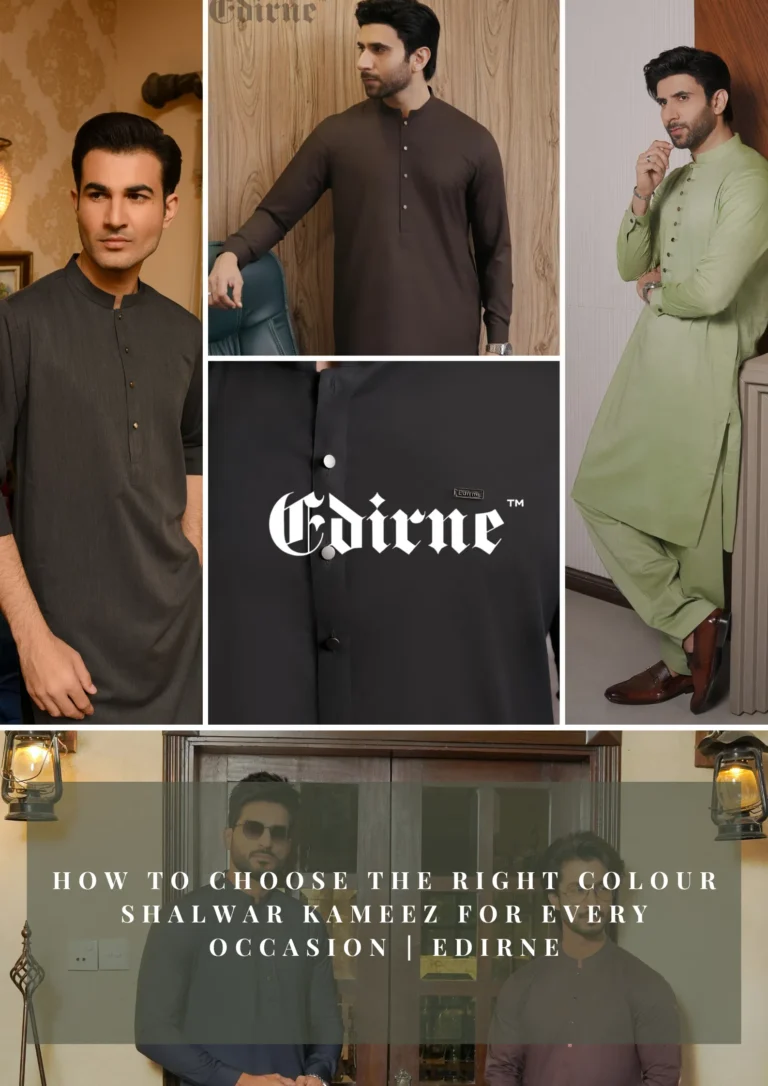
How to Choose the Right Colour Shalwar Kameez for Every Occasion
Before a man is noticed for his tailoring or his fabric, he is noticed for his colour. It happens in the first second of a glance, long before anyone registers the cut of a collar or the weight of the cloth. Colour is the first sentence in the story a shalwar kameez tells about the man wearing it, and it is often the sentence people remember longest.
This is worth pausing on, because most men spend their time thinking about fabric, fit, and finishing, and very little time thinking about colour with any real intention. They choose what looks appealing on a hanger or what a shopkeeper recommends that afternoon. Yet colour carries more weight in how a man is perceived than most realise. It signals mood, occasion, and self-awareness all at once. A well-chosen colour can make an ordinary shalwar kameez look considered and deliberate. A poorly chosen one can make even the finest fabric feel out of place.
This guide is written for men who want to approach that choice with more intention, whether they are dressing for Eid prayers, a wedding, a business dinner, or an ordinary Friday. The goal is not to give you rules to memorise, but to help you understand why certain colours work in certain settings, so that the decision becomes instinctive rather than accidental.
Why Colour Matters More Than Most Men Think
There is a quiet psychology to colour that most men underestimate. The right shade does more than complement your skin tone or the season. It shapes how confident you feel the moment you put it on, and that confidence is visible to everyone in the room before a single word is spoken.
Colour also communicates appropriateness. A shade that feels perfectly at home at a wedding can feel entirely wrong in a boardroom, and a tone suited to a quiet Friday prayer can feel too casual for an evening reception. Men who dress well are rarely the ones with the largest wardrobes. They are the ones who understand which colour belongs where, and they apply that understanding without appearing to think about it at all.
There is also the matter of timelessness. Trends in colour come and go with the same speed as trends in anything else, but certain shades never lose their relevance. A man who builds his wardrobe around these enduring colours rarely finds himself out of place, regardless of how fashion shifts around him. This is one of the quiet advantages of dressing with restraint rather than reaction — you are never chasing anything, because you already own what works.
None of this diminishes the importance of fabric or tailoring. A premium shalwar kameez still depends on the quality of its cloth and the precision of its stitching. But colour is the decision that comes first, and it deserves the same deliberation as everything that follows it.
Choosing Colours for Different Occasions
The most useful way to think about colour is not in isolation, but in relation to the occasion it needs to serve. Every gathering carries its own unspoken expectations, and colour is one of the easiest ways to meet them without effort.
Eid mornings call for something that feels fresh and celebratory without trying too hard. This is where lighter tones tend to feel most natural, though it is not a fixed rule — a well-tailored darker shade can look equally at home at the breakfast table, provided the overall look feels considered rather than heavy for the hour.
Weddings are more forgiving in terms of colour range, but they reward a certain boldness. This is where richer, more expressive tones earn their place, whether that means a deep jewel shade for an evening function or something warmer for a daytime one. Mehndi celebrations, in particular, invite a little more colour play than most other events on the calendar, and this is one of the few occasions where a man can lean into something more vivid without it feeling out of place.
Family gatherings and casual get-togethers ask for something more relaxed. This is where the softer, more understated shades do their best work — colours that feel comfortable rather than occasion-driven, because the setting itself does not demand formality.
Friday prayers occupy an interesting middle ground. They call for a colour that feels respectful and composed, without veering into the formality reserved for business settings. This is often where a man’s most reliable, everyday shalwar kameez earns its keep, week after week.
Business events and formal dinners shift the expectation considerably. Here, colour needs to communicate seriousness and restraint. This is where the deeper, more structured tones consistently outperform anything lighter or brighter, because they read as deliberate rather than decorative.
Evening occasions reward depth. As natural light fades, richer and darker colours tend to hold their character far better than pale ones, which can appear washed out under artificial lighting. This is precisely why certain shades are so strongly associated with evening wear in the first place — they were never really competing with daylight to begin with.
Casual daytime wear, by contrast, is where a man has the most freedom to relax his choices. This is the space for lighter, breathable tones that prioritise comfort and ease over statement-making.
None of these are rigid rules. They are simply observations about how colour tends to behave in different settings, and understanding them gives a man far more control over how he is perceived, without needing to think too hard about it each time.
The Black Shalwar Kameez: Timeless, Versatile, Enduring
If there is one colour that consistently earns its place across occasions, seasons, and generations of Pakistani menswear, it is black. Walk into almost any gathering — a wedding reception, a Friday congregation, a formal dinner — and you will find black shalwar kameez represented more consistently than any other single colour. This is not a coincidence, and it is not simply a matter of fashion. It reflects something deeper about how black behaves as a colour and what it communicates about the man wearing it.
Younger men, in particular, have gravitated toward black shalwar kameez in recent years, and the reasons are not difficult to understand. Black carries none of the ceremonial weight that some traditional colours have accumulated over decades, yet it still feels unmistakably formal when required. It photographs well, it pairs effortlessly with contemporary accessories, and it does not date the way certain trend-driven colours eventually do. A black shalwar kameez purchased today will look just as relevant in five years as it does now, which is precisely what timelessness means in practice rather than in theory.
There is also a practicality to men’s black shalwar kameez that rarely gets discussed alongside its more obvious appeal. It moves from a daytime function to an evening one without ever feeling mismatched to the hour, which is not something every colour can claim. It photographs beautifully under almost any lighting, which matters more than it once did now that so many gatherings live on afterward in photographs. It conceals minor creases and travel wear far better than lighter shades, allowing a man to look composed well into a long day or a long event. And perhaps most usefully, black complements a wider range of skin tones and personal styles than almost any other colour in traditional menswear, which is part of why it sits so comfortably in nearly every man’s wardrobe, regardless of his usual preferences.
Part of black’s enduring appeal lies in what it does not do. It does not compete for attention. It does not demand justification. A man in a well-tailored black shalwar kameez communicates a kind of quiet confidence that louder colours often struggle to achieve, because black allows the tailoring, the posture, and the presence of the wearer to do the talking instead of the colour itself. This is precisely why black works so exceptionally well for evening gatherings — it holds its depth under low light in a way that pale and mid-tone colours simply cannot, appearing richer as the evening progresses rather than fading into the background.
This is also where fabric quality becomes impossible to ignore. Black is an unforgiving colour in the sense that it reveals everything about the material beneath it. A black shalwar kameez made from a lesser fabric can appear flat, slightly grey, or lifeless under certain lighting. The same colour, rendered in a premium fabric with the right weight and weave, takes on a depth that almost looks like it has dimension to it — a richness that catches light rather than absorbing it dully. This is one of the clearest examples of how fabric and colour are never really separate decisions. They influence each other constantly, and nowhere is that more visible than in black.
In fact, black may be the one colour where fabric quality is most visibly rewarded. Lower-grade fabrics tend to flatten black into a single dull plane, with little to distinguish one fold from the next. Premium cottons and carefully developed blended fabrics do the opposite — they hold a subtle sheen along the weave that lets black reveal texture and depth rather than simply absorbing light. Under evening lighting especially, this difference becomes unmistakable: a well-woven black shalwar kameez seems to deepen and soften as the light dims, while a lesser one simply goes flat. This is worth keeping in mind when choosing a premium black shalwar kameez — the fabric is doing far more work than colour alone ever could.
Tailoring, too, becomes far more noticeable in black garments than in almost any other colour. Lighter shades can disguise minor inconsistencies in stitching or fit simply because the eye has more to look at — texture, pattern, the play of light across folds. Black offers no such distraction. Every seam, every finish, every proportion is laid bare, which is precisely why a well-constructed black shalwar kameez looks so quietly impressive, and why a poorly constructed one looks noticeably worse than it would in any other shade. This is one of the reasons an Edirne black shalwar kameez is built with particular attention to construction, since black leaves nowhere for shortcuts to hide.
This is also why fit deserves as much attention as colour when buying ready-to-wear. A premium ready-to-wear shalwar kameez should sit close enough through the shoulders and chest to look tailored, without ever feeling restrictive, and the length should fall with intention rather than accident. In darker colours particularly, a loose or ill-proportioned cut reads immediately, since there is no pattern or lighter shade to soften the silhouette. Men shopping for premium menswear Pakistan-wide have increasingly come to expect this level of fit precision even from ready-to-wear collections, and it is a fair expectation to hold — a genuinely premium garment should never require a second visit to a tailor to look the way it was designed to look.
Styling black well is, in many ways, easier than styling any other colour, because black pairs with almost everything without requiring much thought. A black shalwar kameez with waistcoat in charcoal or deep navy adds structure without competing for attention. A classic leather watch — brown or black, depending on preference — completes the wrist without overstating itself. Footwear in black or a deep oxblood keeps the palette cohesive from head to toe. And when it comes to fragrance, black shalwar kameez pairs particularly well with warmer, deeper scent families — oud, amber, sandalwood — because they share the same quiet intensity that black itself projects. Nothing about this styling needs to be loud. The strength of black lies precisely in how little effort it demands to look considered. For a more detailed look at fabric, fit, waistcoat combinations, footwear and occasion-specific styling, read our complete guide to black Shalwar Kameez for men.
It is also true that black sees a natural rise in popularity during Muharram, when many men choose to wear it as a mark of respect during the month. This is a meaningful part of black’s cultural presence in Pakistan, but it is only one part of a much larger picture. Black is not a seasonal colour, nor is it tied to a single occasion. It moves fluidly from religious observance to wedding functions to business dinners to ordinary weekends, without ever feeling misplaced in any of them. This is what genuine versatility looks like — not a colour that suits one moment particularly well, but one that suits almost every moment reasonably well, which is a far rarer quality than it sounds.
What ultimately makes black so enduring is that it asks nothing of the man wearing it and offers everything in return. It does not go out of fashion because it was never really fashionable in the trend sense to begin with — it is simply foundational, in the same way a well-cut navy suit is foundational in Western tailoring. Any man building a considered wardrobe of ready-to-wear shalwar kameez would be hard-pressed to find a shade that works harder across more occasions than black does.
White: Freshness and Daytime Elegance
If black represents depth and evening sophistication, white represents the opposite end of the spectrum — clarity, freshness, and daytime ease. White has long held a specific association with Eid prayers, and this is not an accident of tradition. There is something about a crisp white shalwar kameez on Eid morning that feels correct in a way few other colours manage, perhaps because white so effectively signals renewal and simplicity at once.
White also performs a practical function that other colours cannot match during Pakistan’s hotter months. It reflects heat rather than absorbing it, and in a country where summer temperatures regularly test the limits of comfort, this is not a minor consideration. A well-made white shalwar kameez in a breathable, high-quality fabric remains one of the most sensible choices for daytime events between April and September.
There is also an understated elegance to white that men sometimes overlook. Because it offers no colour to hide behind, white demands a certain confidence from the wearer, much like black does in the evening. A crisp, well-fitted white shalwar kameez looks deliberately simple rather than merely plain, and that distinction matters more than it might initially appear.
Navy Blue: Formal Sophistication After Dark
Navy occupies a curious space in menswear — dark enough to read as serious and formal, yet without the starkness of black. This makes it an especially strong choice for formal dinners and business-adjacent occasions, where a man wants to appear composed and deliberate without leaning into black’s more assertive presence.
Navy also holds up remarkably well under evening lighting, in much the same way black does, which is why it has become such a reliable choice for evening receptions and formal gatherings that call for something slightly softer than pure black. A navy blue shalwar kameez, cut well and finished in a quality fabric, carries an understated sophistication that reads as considered rather than conservative.
Beige and Stone: Understated Daytime Elegance
Beige and stone tones have earned a steady following among men who prefer their elegance quiet rather than obvious. These are colours that work exceptionally well for daytime events, particularly during the warmer months, when their lighter weight and softer tone feel appropriate to the setting.
There is a certain confidence in choosing beige or stone, precisely because these colours do not shout for attention. They suit a man who understands that understatement, done well, often reads as more premium than anything overtly bold. A beige shalwar kameez, tailored with precision, can look every bit as elegant as a darker, more dramatic shade — simply in a different register.
Grey and Charcoal: Modern Sophistication
Grey and charcoal sit comfortably between the formality of navy and the neutrality of beige, making them particularly well suited to office events and semi-formal daytime occasions. There is a modernity to these tones that feels distinctly contemporary, which is part of why they have found such favour among younger professionals building considered, versatile wardrobes.
Charcoal, in particular, shares some of black’s quiet confidence but with a slightly softer edge, making it an excellent choice for men who want to project understated authority without the starker formality that black sometimes implies.
How Fabric Influences Colour
No conversation about colour is complete without acknowledging the role fabric plays in how that colour is ultimately perceived. The same shade of navy, black, or beige can look entirely different depending on the quality of the material it is woven into. Premium fabrics tend to hold dye more evenly and more richly, which allows colours to appear deeper, more refined, and more consistent across the garment.
This is precisely why two shalwar kameez in the same colour can look so different side by side. A lesser fabric often produces a flatter, less dimensional colour, while a well-woven, higher-grade fabric allows light to interact with the cloth in a way that makes the colour feel alive rather than static. This relationship between fabric and colour is explored in more depth in What Makes a Shalwar Kameez Truly Premium?, which looks specifically at how construction and material quality shape the final impression a garment makes.
Common Colour Mistakes Men Make
A few recurring mistakes tend to undermine what would otherwise be a well-chosen outfit. The most common is selecting a colour without considering the occasion it needs to serve — wearing something suited to a wedding at a business dinner, or something appropriate for Friday prayers to an evening reception. Colour needs to match context, not just personal preference.
Ignoring fabric quality in favour of colour alone is another frequent misstep. A striking colour in a poor fabric will always look less impressive than a more restrained colour in an excellent one, because fabric quality affects everything from drape to how the colour itself reads under light.
Matching too perfectly is a subtler mistake, but a real one. A shalwar kameez, waistcoat, and accessories that coordinate too precisely can start to look styled rather than worn, which paradoxically feels less confident than a slightly more relaxed combination.
Wearing heavy, dark colours during extreme daytime heat is a practical error more than a stylistic one, but it remains common. Comfort and appropriateness should always factor into the decision alongside aesthetics, particularly for outdoor daytime events in peak summer.
Finally, chasing trends over timeless colours is perhaps the most costly mistake in the long run. Trend-driven shades can look current for a season and dated shortly after. Investing in the colours that have consistently proven themselves — black, white, navy, charcoal, beige — tends to serve a man far better over time than chasing whatever happens to be popular this year.
Men looking to understand how fabric choice intersects with seasonal comfort may also find Best Summer Fabrics for Men in Pakistan useful, as it addresses many of the practical considerations that colour alone cannot solve.
Final Thoughts
There is no single colour that outperforms all others across every occasion, despite how often that question gets asked. The right colour is always the one that respects both the setting and the man wearing it — considered against the occasion, the season, and his own sense of self, rather than chosen at random or under pressure to follow whatever is trending.
What separates a well-dressed man from one who simply owns good clothes is rarely the size of his wardrobe. It is his understanding of which colour belongs where, and the quiet confidence that comes from no longer having to think too hard about it. Black will continue to serve him at weddings and evening functions. White will carry him through Eid mornings and summer afternoons. Navy will anchor his formal dinners, and beige will quietly elevate his daytime appearances.
None of this requires excess. It requires attention, a working knowledge of a handful of enduring colours, and a willingness to choose fabric and tailoring that do justice to whichever shade he selects. That, more than any trend, is what timeless style has always been about.