
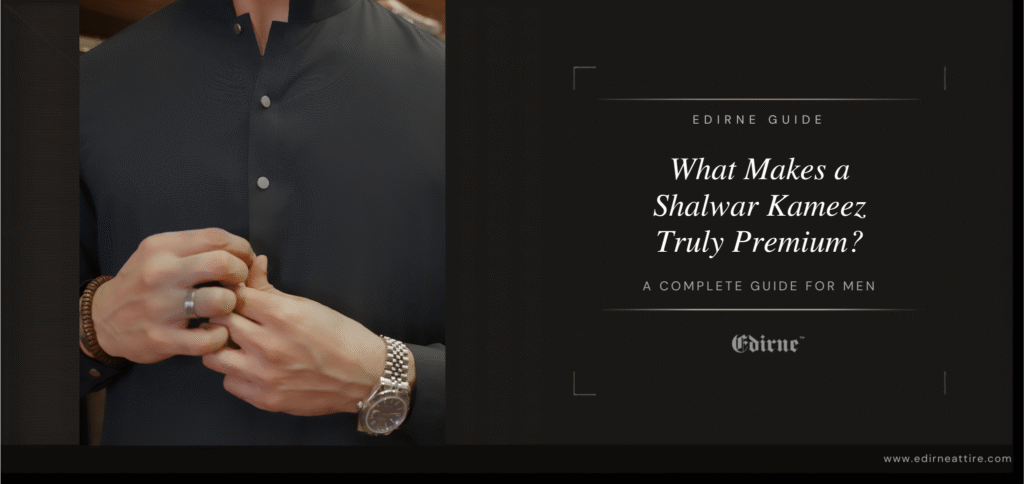
What Makes a Shalwar Kameez Truly Premium? A Complete Guide for Men
There is a particular kind of confidence that comes from wearing clothing that fits correctly, drapes naturally, and holds its form through the day without requiring adjustment or concession. Most men have experienced the opposite: a kameez that creases badly by noon, shoulders that sit an inch too wide, a fabric that looks fine on the hanger but feels stiff and unyielding the moment it touches the skin. The difference between those two experiences is rarely about luck or brand name. It is almost always about quality — the specific, measurable, observable kind.
The market for men’s shalwar kameez in Pakistan spans an enormous range. At one end, you have mass-produced garments stitched quickly from commodity fabric, priced low and replaced often. At the other end, you have a relatively small category of genuinely premium pieces — garments constructed with deliberate choices at every stage, from the sourcing of the cloth to the finishing of the hem. Understanding what separates these two categories is useful not just as a philosophical exercise, but as practical knowledge that protects your investment and elevates your daily experience of getting dressed.
This guide is written for the man who wants to buy well, not simply buy more. Whether you are exploring Edirne’s shalwar kameez collection or evaluating options from any premium menswear source, the principles here will serve as a reliable framework for making informed decisions.
Why Premium Matters Beyond Price
Before examining the specific markers of quality, it is worth addressing a fundamental question: does premium genuinely perform differently, or is it simply a matter of perception?
The answer, in the context of menswear, is unambiguously the former. A premium garment is not merely more expensive — it is engineered to a higher standard that produces tangible results. It holds its shape across repeated washing. It breathes more effectively in warm climates. It recovers from being folded or packed without becoming a map of permanent creases. It sits correctly on the body without constant repositioning. These are not subjective luxuries. They are functional advantages that accumulate over months and years of wear.
The calculus of value in premium clothing is also worth understanding. A well-constructed shalwar kameez purchased at a higher price point will almost always outlast three or four cheaper alternatives. When you factor in the cost-per-wear across its lifespan, the economics often favour the premium option substantially. More importantly, the daily experience of wearing something well-made is qualitatively different — it is quieter, easier, and more assured.
Fabric: The Foundation of Everything
No single factor determines the quality of a shalwar kameez more than the fabric from which it is made. Construction and fit can only work with what the cloth allows. A skilled tailor cannot fix a poor fabric. Understanding the significant distinctions between textile sources and grades is therefore the most important knowledge a buyer can carry.
Turkish Cotton is among the most refined in the world, and for good reason. The Aegean region of Turkey produces long-staple cotton fibre with a smoothness and tensile strength that sets it apart from standard-grade alternatives. Long-staple simply means that each individual fibre is longer before it is spun into yarn, which produces a thread that is finer, stronger, and less prone to pilling. The resulting fabric has a naturally lustrous surface, a cool hand feel, and a drape that moves with the body rather than against it. In warm climates like Pakistan’s, Turkish cotton performs particularly well because of its open-weave breathability and its ability to wick moisture efficiently without retaining it.
Egyptian Cotton — specifically the Giza varieties grown along the Nile — carries a similar premium for similar reasons. It is extraordinarily fine, soft, and strong. Egyptian cotton is often used in garments where comfort against the skin is paramount, and it has a breaking strength that makes it exceptionally durable even when woven at high thread counts. It softens further with each wash rather than degrading, which means a well-made Egyptian cotton kameez genuinely improves over time. For a detailed discussion of how these and other fabrics behave in Pakistan’s climate, the editorial piece on best summer fabrics for men in Pakistan offers useful technical context.
Italian Cotton represents the finishing end of the cotton spectrum — fabric that has typically been processed, mercerised, or woven in Italian mills where centuries of textile manufacturing have produced techniques unavailable elsewhere. Italian cotton is often distinguished less by its fibre origin than by the precision of its finishing: the evenness of its weave, the consistency of its dye uptake, and the specific hand feel that results from being processed with exacting attention to detail.
When evaluating fabric before purchase, hold it up to light. Premium fabric has an evenness of weave — a consistency in the spacing between threads — that commodity fabric lacks. Run it between your fingers. It should feel smooth without being synthetic-smooth, and cool to the touch even at room temperature. Scrunch a section briefly in your fist and release it. Premium natural-fibre fabrics spring back relatively quickly. Fabrics with high synthetic content or poor processing retain a fist-shaped crease.
Construction and Stitching: Where Longevity Is Determined
The fabric is the foundation, but construction is the architecture. Two garments can be made from identical cloth and differ dramatically in how they hold together and how they age, depending entirely on how they were assembled.
Stitch density is a reliable initial indicator. Premium garments carry more stitches per inch, which distributes tension across the seam more evenly and dramatically reduces the likelihood of seam failure under normal stress. Low-cost stitching tends toward speed, which means fewer stitches per inch and seams that begin to fray or split after moderate use.
Seam finishing is an equally important detail, and one that is invisible from the outside unless you take a moment to check. Turn the garment inside out. In a premium piece, seam edges will be cleanly finished — overlocked, french seamed, or bound — so that the fabric cannot fray from the inside out. In lower-quality garments, raw edges are common, and these become the first points of structural failure after washing.
The collar and cuff attachments on a kameez deserve specific attention because these are stress points subject to regular pulling and adjusting. A collar that is cleanly turned, pressed flat, and attached with consistent stitching at every millimetre will maintain its shape across hundreds of wears. A collar attached quickly, with visible irregularities at the corners or where it joins the neckband, will begin to lift and distort within a few months.
Buttonholes, when present, should be cleanly cut and tightly bound, with no loose threads at the ends. The buttons themselves should be securely attached, and on a truly premium garment, thread loops and buttons will be reinforced at the back.
Fit and Silhouette: The Visual Grammar of Quality
A premium fabric and excellent construction are rendered meaningless by poor fit. Conversely, a well-fitted garment in a fine cloth communicates quality instantly and effortlessly. Understanding the markers of proper fit in a shalwar kameez allows you to evaluate a garment accurately regardless of the label inside it.
The shoulder seam is the most critical fit point in any upper garment. On a kameez, the shoulder seam should sit at the precise edge of your shoulder — not rolling forward toward your chest, and not hanging back over the curve of your deltoid. When the shoulder seam is placed correctly, the rest of the garment hangs naturally and the fabric lies flat across the chest and upper back without pulling or gathering.
Kameez length is a matter of proportion as much as personal preference, but a well-made garment will be constructed with the awareness that length affects the entire visual line. For most men, the hem falling at mid-thigh creates the most balanced silhouette, but the key is that the length feels deliberate — neither accidentally short nor unnecessarily long.
Sleeve length in a premium kameez reaches the wrist cleanly, and the sleeve head — the curve at the top of the sleeve where it joins the armhole — is set high enough to allow free arm movement without distorting the shoulder. A sleeve set too low creates a characteristic pulling effect across the upper back whenever the arm is raised, which is the hallmark of imprecise tailoring.
The chest and waist fit should allow ease of movement — two or three inches of ease at the chest is comfortable — but should not be so voluminous that the fabric billows or sacks. Excess fabric at the sides, particularly when viewed from behind, typically indicates a garment cut for a generic size range rather than a considered silhouette.
The Difference You Notice Over Time
One of the most reliable tests of a garment’s quality is not how it looks when new, but how it looks after six months of regular wear. Premium garments age with what might be described as dignity. Their colours fade gradually and evenly rather than in patches. Their fabric softens rather than weakens. Their seams remain secure. Their shape is retained without the need for starch or heavy pressing.
Lower-quality garments, by contrast, often look and feel acceptable when new, but reveal their limitations within months. Pilling appears on the chest and underarms. Seams begin to separate at points of stress. Collars lift and lose their structure. Dyes bleed unevenly. The garment starts to look worn in the specific, unflattering way that is distinct from the natural patina of quality clothing over time.
This is why experienced buyers in menswear — whether in Karachi, London, or Milan — often speak of investing in a wardrobe rather than replacing one. The premium option costs more upfront and costs less overall. More importantly, it asks less of you on a daily basis. You put it on. It works. This is the quiet dividend of buying well.
How to Evaluate a Shalwar Kameez Before Buying
Translating the above principles into a practical pre-purchase assessment takes less time than most people assume. The following checklist can be conducted in two to three minutes in any showroom or at the point of receiving an online order.
Examine the fabric first. Hold it to light and assess the weave. Rub it between your fingers and note how it feels against skin. Scrunch and release to test its recovery. Ask specifically about the fabric origin if you are not certain.
Check the stitching inside the garment. Look at the seam finishing and stitch density. Inspect the collar attachment and any buttonholes. Look for reinforced stress points at the cuffs and shoulder seams.
Assess the fit against your own measurements rather than the labelled size. Shoulder placement and chest ease are the two dimensions most worth measuring before purchasing, as alterations to these areas are either impossible or expensive.
Look at the overall construction with the garment held up at arm’s length. Does it hang symmetrically? Does the collar sit flat and centred? Does the hem appear even from side to side?
Finally, examine the finishing details: the press, the alignment of any placket or embroidery, the quality of the thread used in topstitching. In a premium garment, none of these elements will look incidental.
Why Fabric Sourcing Matters More Than Marketing
In a category saturated with labels claiming quality, the question of where a brand actually sources its fabric is one of the most meaningful points of differentiation. The supply chains behind premium textile production are genuinely more demanding and more expensive than commodity alternatives. A brand that invests in Turkish or Egyptian cotton is committing to a higher cost of goods before a single stitch is placed — a commitment that is reflected in the finished garment’s performance, not merely its price point.
Edirne works from the premise that the quality of the cloth is not negotiable. The fabrics used in its shalwar kameez and kurta pajama collections are sourced from suppliers whose textile reputations are built on fibre grade and processing precision rather than volume. This approach is less efficient commercially and more demanding operationally. It is also the only approach that produces garments capable of performing at the level described above.
For those in Karachi who prefer to assess fabric quality in person before purchasing, the Edirne atelier is located in Zamzama, DHA Phase V — an area that has quietly become one of the more considered addresses for premium menswear in Pakistan, as explored in detail in this overview of menswear brands in Zamzama. The boutique can be reached directly via Google Maps, and the experience of feeling the fabric collections in person tends to resolve any remaining questions about the difference that sourcing makes. For those already familiar with the Zamzama address, the editorial guide to the best shalwar kameez options for men in the area provides additional comparative context.
Frequently Asked Questions
What fabric is best for a premium shalwar kameez? Premium Turkish, Egyptian, and Italian cotton fabrics are among the finest choices available, prized for their breathability, durability, and refined drape. Each origin brings specific characteristics — Turkish cotton for its lustrous surface and moisture-wicking properties, Egyptian cotton for its extraordinary softness and long-term resilience, and Italian-processed cotton for the precision of its finishing. The right choice depends on the occasion, the season, and the level of formality required.
How can you tell if a shalwar kameez is high quality? The most reliable indicators are fabric hand feel, stitch density, seam finishing, collar construction, and overall fit. Examine the inside of the garment for clean, finished seams. Assess how the fabric recovers from scrunching. Check that the shoulder seam sits precisely at the edge of the shoulder and that the collar lies flat without lifting. A garment that holds its structure under these assessments will almost certainly hold it across regular wear.
Why are premium shalwar kameezes more expensive? The cost of a premium shalwar kameez reflects decisions made at every stage of its production. Higher-grade fabrics from specialist textile regions cost significantly more at source. Precise cutting and higher stitch density require more time and more skilled labour. Superior finishing — clean seam edges, reinforced stress points, consistent pressing — adds further to the manufacturing time. And because the resulting garment lasts considerably longer than a cheaper alternative, its true cost over time is often lower despite the higher upfront price.
Is cotton the best fabric for shalwar kameez in Pakistan? For most of the year, premium cotton remains one of the most comfortable and versatile choices given Pakistan’s climate. Its breathability in warm months and its ability to layer comfortably in cooler seasons make it a dependable option across occasions. The distinction lies not in cotton versus other fibres, but in the grade and origin of the cotton itself — which is where the meaningful differences in comfort and performance are actually found.
Final Thoughts
Buying a premium shalwar kameez is ultimately an exercise in attention — attention to fabric, to construction, to fit, and to the specific ways these elements interact to produce a garment that performs reliably across time and across occasions. It requires asking better questions than the market generally encourages: not just what does this cost, but what is this made of, and how was it made, and how will it hold up.
The answers to those questions will not always be convenient. Premium cloth costs more. Precise construction takes longer. A garment made at this standard cannot be priced at the same level as one that cuts corners invisibly. But the man who understands these distinctions is not paying more for a label or a postcode. He is paying for something that will be a reliable, comfortable, and well-looking presence in his wardrobe for years — not months — and that will, in time, prove itself the more economical and more satisfying choice.
That, in the end, is what makes a shalwar kameez truly premium.